Alan Lee’s pencil drawings and watercolours have helped generations of readers—and film audiences—picture Tolkien’s Middle-earth.
A closer look at the work
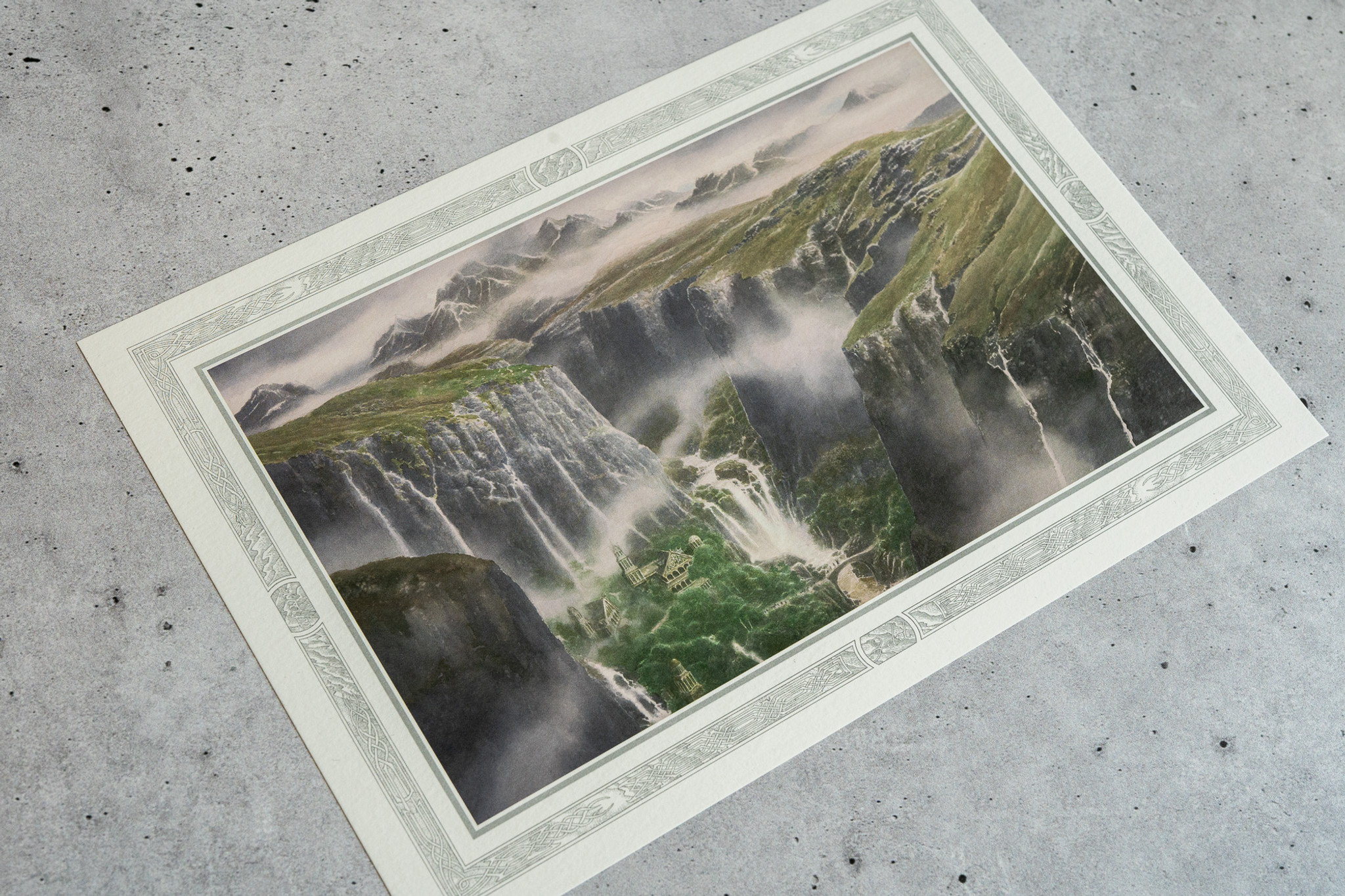
This landscape draws attention down into the valley through waterfalls and pale bands of mist. The architecture remains small, allowing the cliffs to establish a sense of age and scale. Soft atmospheric passages separate the distant mountains from sharper foreground rock, while restrained greens keep the scene unified. For an environment study, focus on those overlapping value groups first. The detail matters because it belongs to a coherent landscape, not because every surface receives equal emphasis.
A life in illustration
In a 2017 interview with Tolkiendil, Lee traced his path back to childhood drawing. A school with a specialised art class gave him substantial time to practise; at sixteen he entered art school, studying graphic design with an emphasis on illustration. His work would come to connect printed stories with the visual development of films.
HarperCollins describes the special illustrated edition of The Hobbit, commissioned sixty years after the novel’s 1937 publication, as a landmark in that relationship. Lee’s delicate pencil work and watercolours later contributed to the visual world of Peter Jackson’s adaptations. The Hobbit Sketchbook returns to the process, combining images with his explanations of how they developed.
Recognition on screen
At the 2004 Academy Awards, The Return of the King won for Art Direction. The Academy credits Grant Major for art direction and Dan Hennah and Alan Lee for set decoration. The precise credit matters: creating a film’s visual world is a shared effort across design and production departments.
Serving the reader’s imagination
Interviewed by Tolkien Library in Paris in 2008, Lee described illustration as work bound to a text and intended for a printed page. He emphasised helping tell the story without crowding out the reader’s imagination. He also explained why keeping original artworks could be useful when future editions required new scans.
Those observations reveal practical concerns behind the atmosphere: an illustrator is making images for a particular format, a particular story and readers who already have pictures of their own in mind.