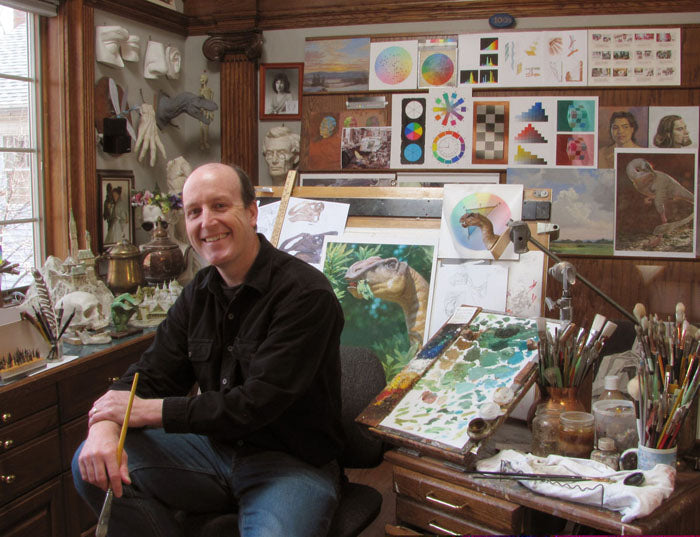
James Gurney brings an illustrator’s imagination together with the patient observation of a painter working from life.
Building a believable imaginary world
Born in California in 1958, Gurney studied anthropology at the University of California, Berkeley. His official biography describes a career that began with paperback covers and included background painting for Fire and Ice. He coauthored The Artist’s Guide to Sketching in 1982.
Historical reconstruction became another important strand. Assignments for National Geographic asked him to depict ancient civilisations; the research helped lead to the lost-world paintings that developed into Dinotopia: A Land Apart from Time, published in 1992. His methods included working with posed models and handmade maquettes to give imagined scenes a physical foundation.
From painting to teaching
Imaginative Realism followed in 2009 and Color and Light in 2010. These titles make his process especially relevant to artists who want to move from collecting inspiration to understanding how an image is constructed. His official website also presents outdoor painting and demonstrations in gouache, watercolour, casein and oils.
Why he belongs in a digital artist’s library
Gurney is not primarily a Photoshop instructor. The connection is the underlying visual problem: how to make light, colour, space and invented subjects convincing. A software-specific tutorial may show where a control lives; studying a painter’s decisions can help explain what to do with it.
Start with the artist’s own books, demonstrations and writing. Separating his published explanations from our interpretation is important: the recommendation here is to study the decisions, not to assume that a traditional workflow must be copied literally into a digital one.