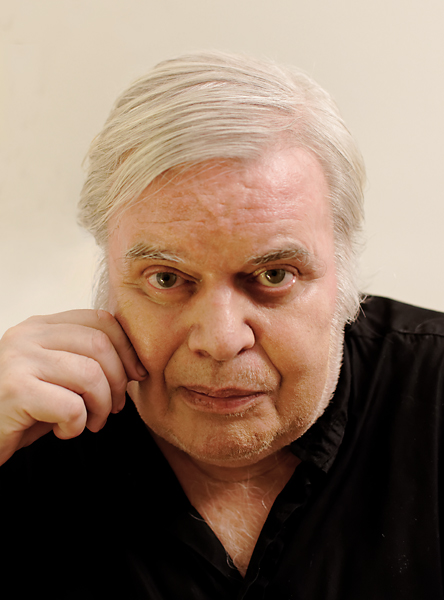
H. R. Giger developed a visual world in which bodies, machines and architecture seem to share the same anatomy. Although Alien made his work familiar to cinema audiences, that world grew out of an independent practice spanning drawing, painting, sculpture and design.
Building a biomechanical language
Hans Ruedi Giger was born in Chur, Switzerland, in 1940. The HR Giger Museum's biography describes his industrial-design studies in Zurich and an imagination influenced by dreams, nightmares, literature and artists including Hieronymus Bosch and Salvador Dalí. His early ink work preceded the airbrush paintings for which he became widely known. The museum describes biomechanics as a fusion of human and machine, an organizing idea that connected his work across different materials.
The artist's official biography identifies his 1977 collection Necronomicon as a key visual inspiration for Ridley Scott's Alien. His contribution extended beyond the adult creature to its developmental stages and extraterrestrial surroundings. The film's visual-effects work earned him an Academy Award in 1980. Thinking across a creature and its environment helps explain why the resulting imagery feels like a coherent world rather than a disconnected monster design.
When a visual style becomes a place
Giger's practice also became physically inhabitable. The museum's account of its founding records his purchase of Château St. Germain in Gruyères in 1997 and the museum's opening the following year. Its collection includes drawings and designs for projects such as Alien, the unrealized Dune, Species and Poltergeist 2. The adjacent bar, completed in 2003, extends his forms across furniture, walls and ceilings. Giger died in 2014.
A study exercise from our editors
Instead of copying a famous creature, investigate the idea of a consistent design family. Pick one natural structure, such as a rib, seed casing or insect joint, and one ordinary mechanical object. Draw three combinations, then apply the strongest shape relationship to a doorway, a chair and a fictional tool. Keep the subject matter your own and test whether the three objects look as though they belong together. In Photoshop, begin with broad light and dark shapes before adding repeated details. This is our editorial exercise in visual consistency, not an exercise attributed to Giger.