Syd Mead made the future look as though somebody had already worked out how to live in it. His career connected industrial design, commercial illustration and cinema, making him a valuable artist to study when an invented world needs more than an impressive silhouette.
A closer look at the work
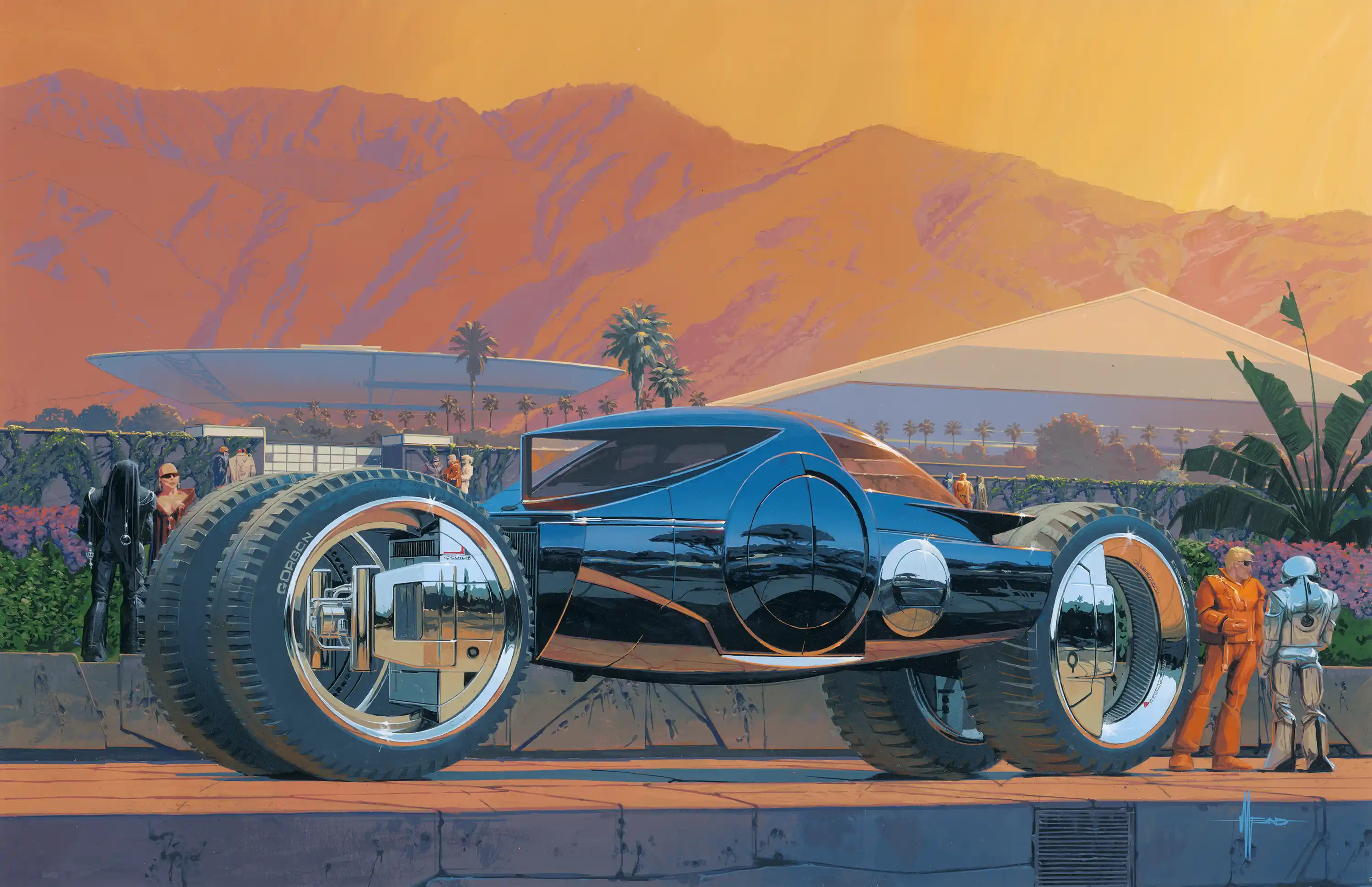
The enormous wheels and low, enclosed cabin establish the vehicle’s proportions immediately. Reflective panels carry fragments of the surrounding landscape, making the invented machine feel physically present rather than pasted into a background. Small standing figures provide scale, while the sweeping architecture repeats the vehicle’s long horizontal movement. The orange sky and blue bodywork also create a clear color hierarchy. A useful exercise is to design the silhouette first, then use reflections to explain the curvature of its surfaces.
From the drawing board to the screen
Born in St. Paul, Minnesota, in 1933, Mead graduated from Art Center School in Los Angeles in 1959 and moved into automotive design at Ford. His official biography traces the later move into film through Star Trek: The Motion Picture, Blade Runner, Tron and Aliens. These productions brought his ideas to audiences far beyond the companies commissioning his earlier illustrations. His estate's biography emphasizes that he considered practical questions and whole situations when developing a design.
The official career timeline adds useful context to that reputation. Long before his best-known films, Mead illustrated forward-looking ideas for U.S. Steel. He founded Syd Mead, Inc. in Detroit in 1970; the same period included Philips assignments and Concorde interior concepts for Raymond Loewy Associates. His 1976 book Sentinel preceded his major cinema credits. Film design was one branch of a much broader practice involving products, vehicles and architectural illustration.
The environment is part of the design
Mead's estate describes a process in which objects belong to larger, functional settings. It also records his adoption of computer illustration in the 1990s and his teaching through lectures and the Techniques of Syd Mead series. He died in 2019. For a Photoshop painter, the useful connection is between presentation and explanation: rendering can show how a design works, not simply how expensive its surfaces appear.
A study exercise from our editors
Choose one vehicle image in the official timeline and make a small diagram of its relationship to the people around it. Where do passengers enter? What establishes scale? Which surrounding structures explain the vehicle's purpose? Then design a different vehicle for an everyday job, such as collecting recycling. Give it a loading area, a driver and somewhere to stop. Keep the first painting in three values. Resolve those relationships before adding material effects or decorative lights. This is our suggested exercise, not a lesson attributed to Mead.