A percentage can travel much further than its qualifications. Before Adobe’s new AI survey becomes a claim about what every illustrator should do, it is worth slowing down and asking whose experience the numbers describe.
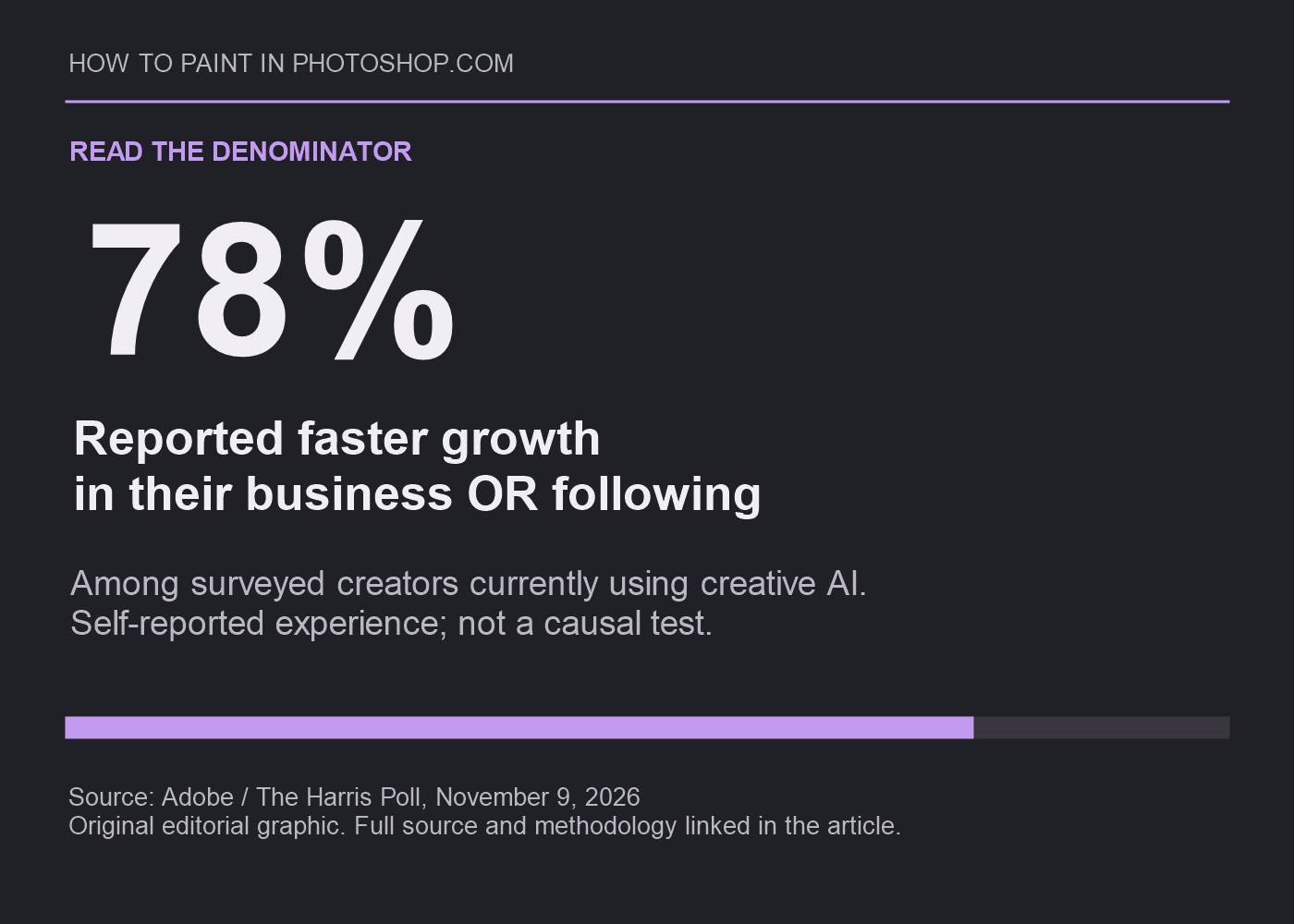
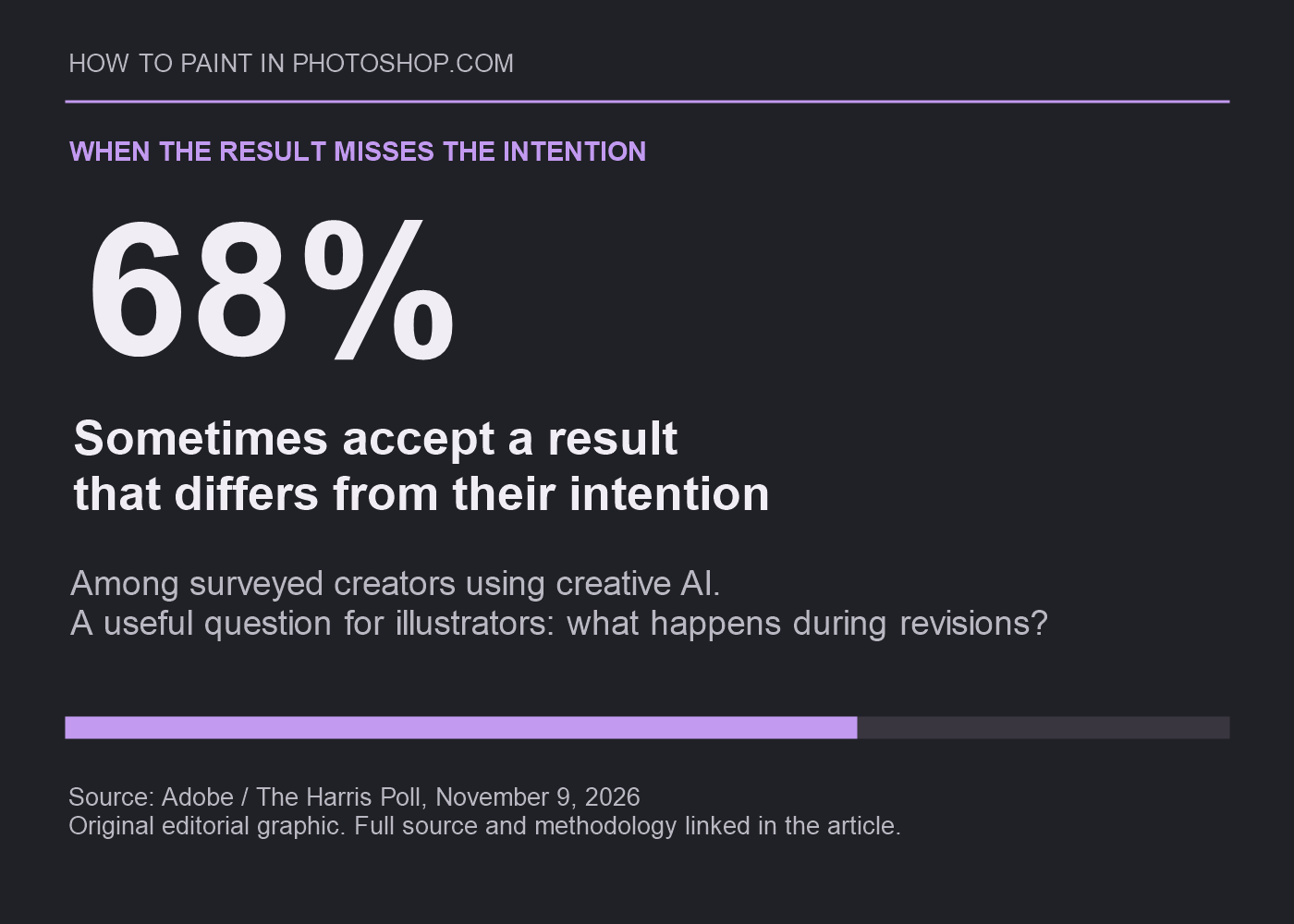
Adobe’s November 9 announcement reports an October survey conducted with The Harris Poll among more than 2,000 US creators. Participants included emerging and full-time creators who publish digital content several times a month. Among current creative-AI users, 78% said it had accelerated their business or audience growth; 68% said they sometimes accepted results that missed their original intention.
Start with the person behind the percentage
That is a useful account of respondents’ experiences. It is not a census of concept artists. A person publishing cooking videos, an illustrator selling commissions and an environment artist working on a confidential film can have very different definitions of success. A larger audience might be crucial to one and largely irrelevant to another.
The distinction becomes especially important when a headline turns into career advice. Before applying a result to your own work, ask whether the people answering face comparable briefs, deadlines and approval processes. Sharing a drawing application does not automatically make two jobs comparable. Their deliverables and working relationships matter at least as much.
Growth needs a more precise definition
Consider two hypothetical outcomes: one artist gains followers but receives no additional commissions; another completes fewer projects while earning more from each. Both could describe progress. They would nevertheless require different evidence if we wanted to understand income, workload or stability. Combining different outcomes into one headline leaves those distinctions unresolved.
Nor does a respondent’s explanation establish what would have happened without the tool. Perhaps a new client, a stronger portfolio or more time spent publishing also contributed. These are possible alternatives, not findings about this survey. To isolate a cause, we would need evidence designed to compare explanations, rather than simply replace one confident story with another.
The revision is where the question gets interesting
For an illustrator, a promising first image is only one stage of a job. Imagine an art director asking for a different hand gesture while keeping the costume, perspective and expression intact. The useful question is whether the change can be made deliberately, checked and repeated. A pleasing alternative image does not necessarily answer that request.
This is why the gap between intention and result deserves attention. In a personal experiment, an unexpected variation may be welcome. In a continuity-sensitive sequence, the same variation may create work elsewhere. Neither situation supplies a universal verdict on AI. They show why a production decision needs the context of the actual assignment.
A practical comparison would therefore count the entire task: setup, exploration, correction, review and delivery. It would record which parts remained editable and which had to be rebuilt. This is a proposed evaluation method, not a test performed for this article. Without those observations, a fast preview can easily be mistaken for a faster completed job.
Read the methodology before adopting the message
The AAPOR disclosure checklist provides a useful reading framework: identify the population, recruitment method, questions, sample sizes and weighting. Those details help establish which comparisons a survey can support. A headline percentage cannot supply them by itself.
Pay particular attention when a result concerns a subgroup. A large overall sample does not tell us how many specialist illustrators answered a particular question. We should not invent that number, assume every respondent fits that occupation, or treat missing detail in a short announcement as proof that the underlying research is fraudulent.
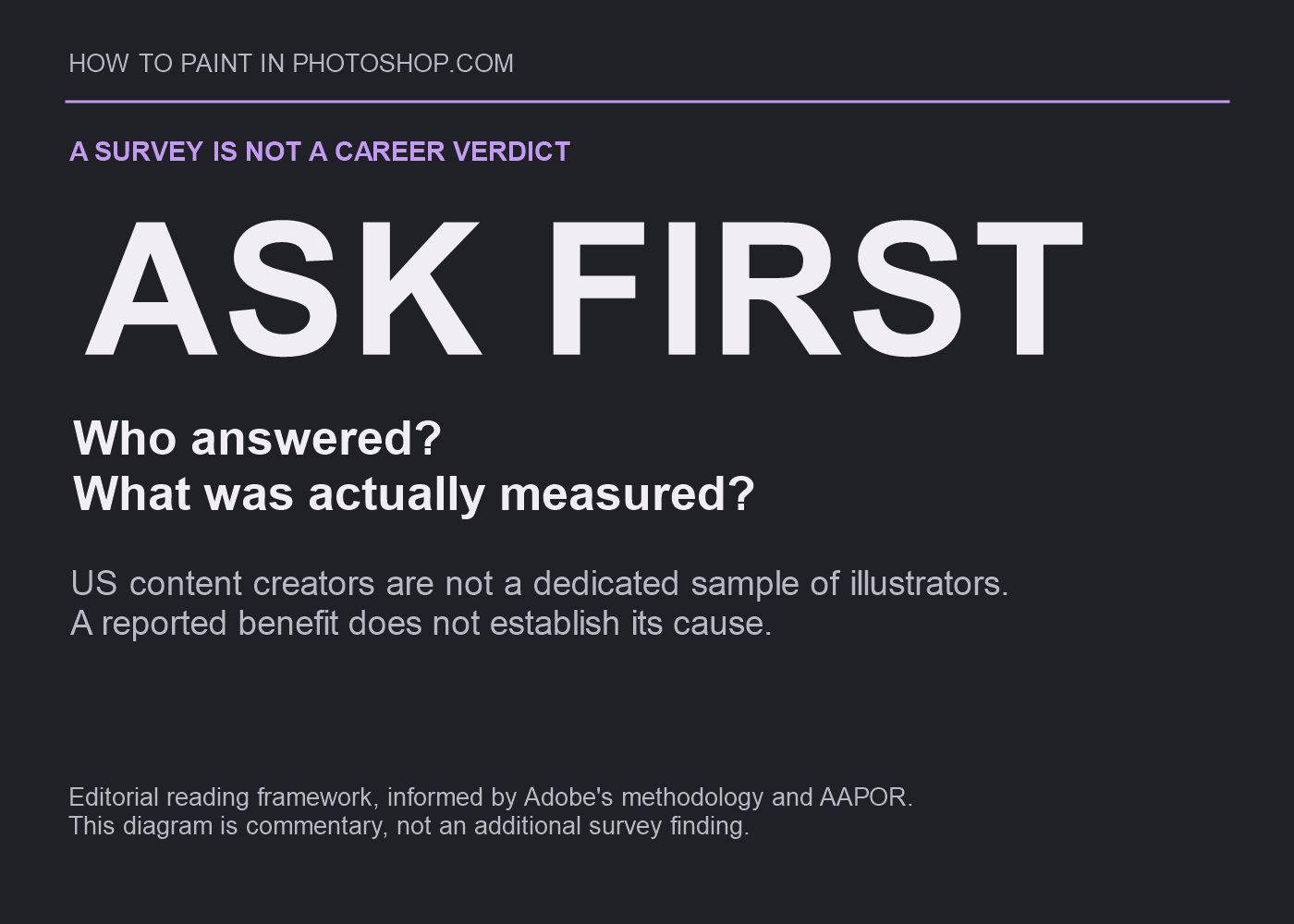
There is a further distinction between an average experience and a dependable production promise. Even a widely reported benefit does not specify how a tool behaves on your next difficult revision. A useful trial should include the awkward case, not only the attractive demonstration: a recurring character, a fixed composition or a change that must leave everything else untouched. That is where control becomes observable.
A reason to ask better questions
Adobe is presenting the findings through its own company blog. That context belongs beside the numbers: the announcement is also a product-company communication. It does not make every result wrong. It does mean readers should distinguish the reported answers from the broader story the publisher wants those answers to tell.
An illustrator can also have reasons for accepting or rejecting a tool that a growth statistic cannot settle. Authorship, client requirements, the ability to explain decisions and the kind of practice someone wants to develop are separate questions. A survey about adoption cannot decide those priorities on an artist’s behalf, and a popular workflow does not become compulsory.
The most useful response is neither panic nor a purchase made to avoid falling behind. Ask what outcome matters for your work, what evidence would demonstrate an improvement, and what would count as an unacceptable compromise. Then read the survey within those limits. It can inform a conversation about tools; it cannot replace a considered judgement about your craft.