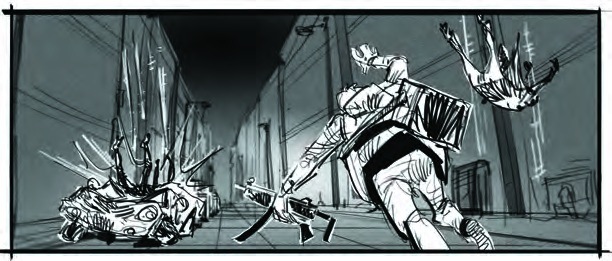
The street tilts, the building pulls away above us, and a running figure has very little room left in the frame. Then the creature breaks in from the left. Micah Brenner’s Resident Evil board is crowded in exactly the places that make escape feel difficult. You can read the problem before you have worked out every limb.
Brenner’s Residing With Evil, in Perspective’s September–October 2026 issue, describes his storyboarding work with director Zach Cregger. These selected drawings are useful to study at two speeds: first as immediate pictures, then as instructions for moving a camera and organising a production. The discussion below is our visual reading of the artwork, alongside Brenner’s account of the process.
The rough drawing already needs a decision
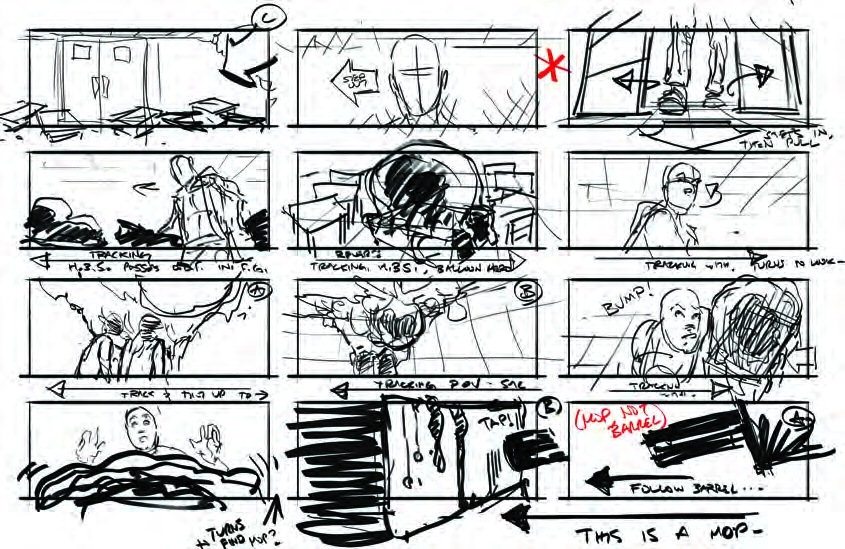
The maternity-ward sheet is full of abbreviated bodies and overlapping lines. A few marks establish a bed, a doorway or the direction a head is facing. Arrows extend beyond the frames. Some marks are cancelled. It looks like a conversation still happening, rather than an illustration waiting to be approved.
There is nevertheless a hierarchy. Rectangles hold the shots apart; dark clusters mark where bodies or an interruption will matter. The figures do not all need convincing faces. They need convincing positions in relation to the bed, the opening and each other. That is enough information to ask whether the next shot makes sense.
Brenner describes drawing thumbnails during screen-shared Zoom calls while Cregger dictated shots, spending roughly 30–90 seconds on each. He refined them afterwards. That sequence matters: the first drawing has to hold the staging before additional rendering can clarify it.
On the street board, the open patch of pavement is almost as important as the figures. It supplies a possible route, while the diagonals above and the burst at the side threaten to close it. Try covering that gap with a finger: the action becomes harder to place even though the running pose has not changed.
Give the darkness a measurable shape
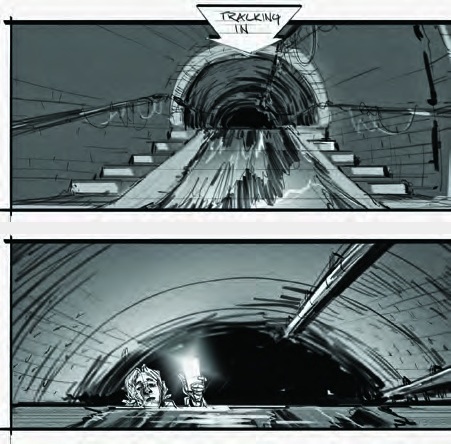
The sewer entrance is built around a receding arch. Steps and wall courses narrow towards it, while the central channel carries our eye into the black. There is very little happening in the first selected frame. That emptiness has a precise location, which gives us somewhere to expect a change.
In the next board, a small head interrupts the curve. The architecture does not need a new design to produce a different feeling. A shape has entered a place we were already watching. The drawn arrow and camera note make the intended approach explicit; perspective establishes the space, while the annotation explains how the shot should move through it.
A reaction and a point of view do different work
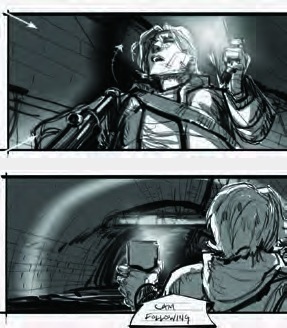
The closer drawing puts the face and the raised light together. The bright spot sits beside the head, and the cable-like lines behind it remain subordinate. We can see someone trying to examine the surroundings without the surroundings taking over the picture. The shoulder and arm also make the light feel held, rather than conveniently placed.
The following selection turns us towards the tunnel over that person’s shoulder. The back of the head occupies one edge; the illuminated opening is farther away. We have exchanged access to an expression for access to what the person is watching. Read the two together and the change is clear. A single wide illustration would have difficulty giving both relationships equal force.
Keep the instruction visible
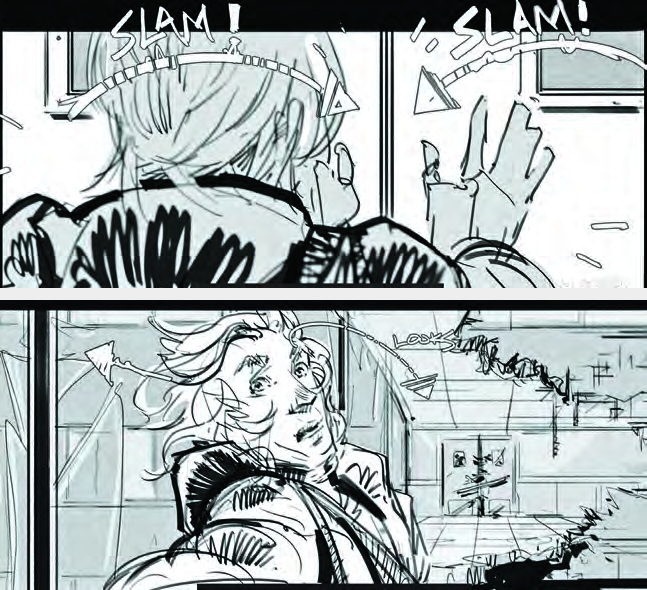
Near the door, the lettering and heavy movement marks are impossible to mistake for background decoration. The first image compresses the head beside the closing surface. The next opens the space behind the turning figure. Glass, shelving and hanging details establish an interior without needing an inventory of every object.
The turn is especially useful to an illustrator: a different arrangement of shoulders, hair and face can redirect attention before the viewer has inspected the room. The broad dark foreground shape pushes the lighter head forward. These are economical drawing choices, but they describe a specific action. Removing the marks for the sake of a cleaner portfolio image would also remove part of the explanation.
The board has another audience: the crew
Brenner recalls the completed boards being printed and placed along the hallway outside Cregger’s office. Department heads could pass through the sequence on their way to ask questions. A readable run of images could communicate decisions beyond the storyboarding meeting.
Try looking back through these selections with that audience in mind. Can someone locate the entrance? Tell whether we are approaching it? Understand whose view the next image gives us? The answers come from framing, contrast and a few unusually direct notes. Polishing the texture of a wall would not repair a missing answer. The drawing earns its detail when it makes the intended shot easier for another person to understand.