A black coat against a dark building sounds like a recipe for losing a character. Jay Martin’s Spider-Noir drawings make it work with a few sharply chosen interruptions: pale eyes, a rim of light along a shoulder, a moon placed behind the head. The figure stays readable because the darkness has been organised. That is what makes these pages worth studying beyond their connection to a superhero.
These drawings accompany Jay Martin’s Storyboarding Noir, a report on the television series in Perspective’s May–June 2026 issue.
A silhouette can carry the first reading
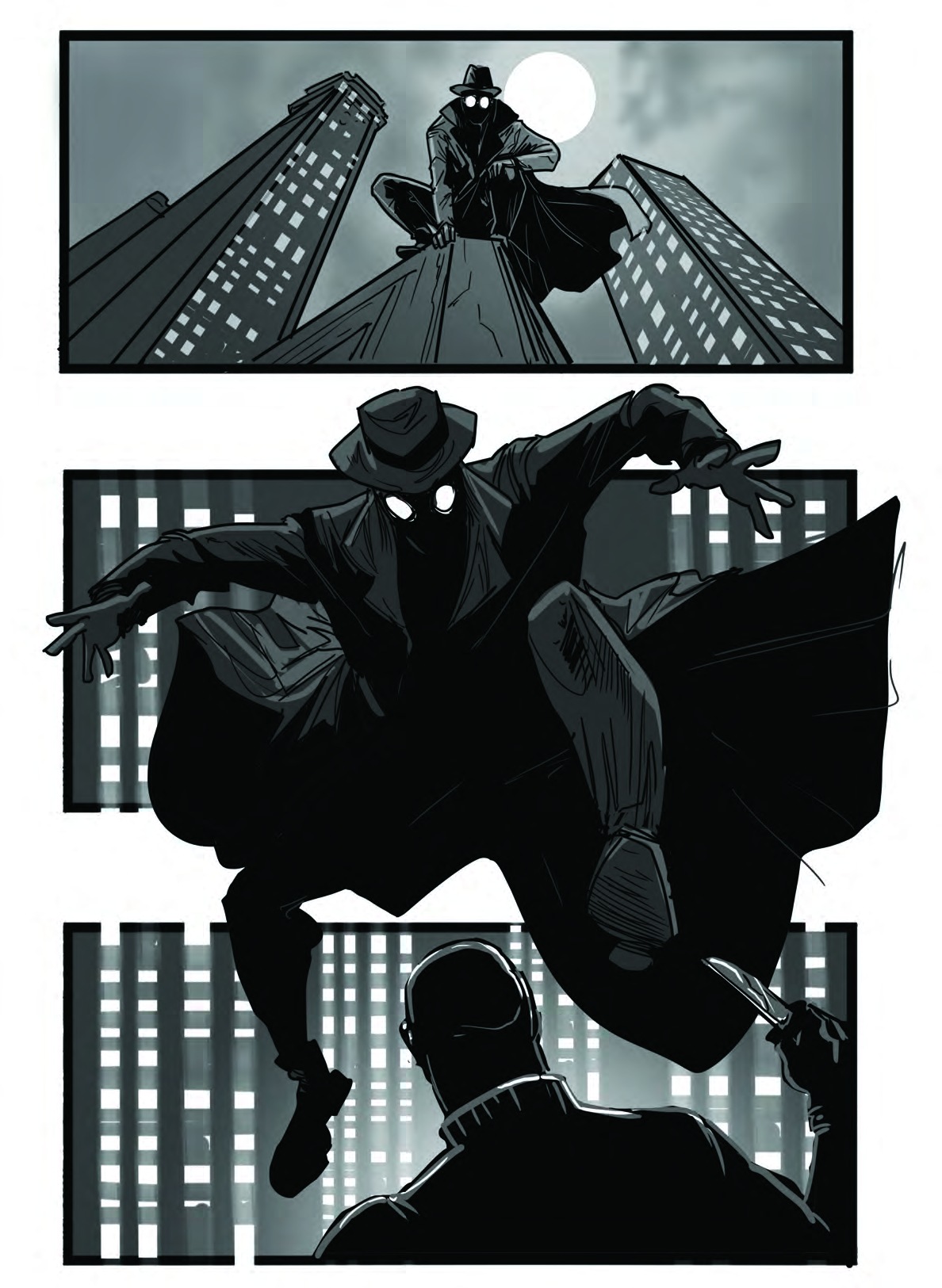
The audition sample above moves from a crouch on a rooftop to a figure dropping towards us. In the upper image, the buildings lean inward and the moon separates the head from the sky. The coat remains a large, mostly quiet mass. Its outline does more work than the folds inside it.
The next drawing pushes the hands, knees and coat outward. The body breaks across the rectangular frame, while the opponent’s head occupies the bottom edge. We understand the relationship before we have examined the costume. One person is descending into another person’s space.
Notice the windows. They describe the city without turning every building into a separate attraction. Their pale rectangles also help reveal the dark figure in front of them. This is a useful way to think about background detail: the same marks can establish a setting and support the action, provided their contrast is placed carefully.
The opponent’s knife is a small shape at the right edge, but it changes how we read the descent. The drawing gives both sides of the encounter a visible intention. That little interruption keeps the pose from becoming an isolated character illustration.
Keep the rough drawing open to change
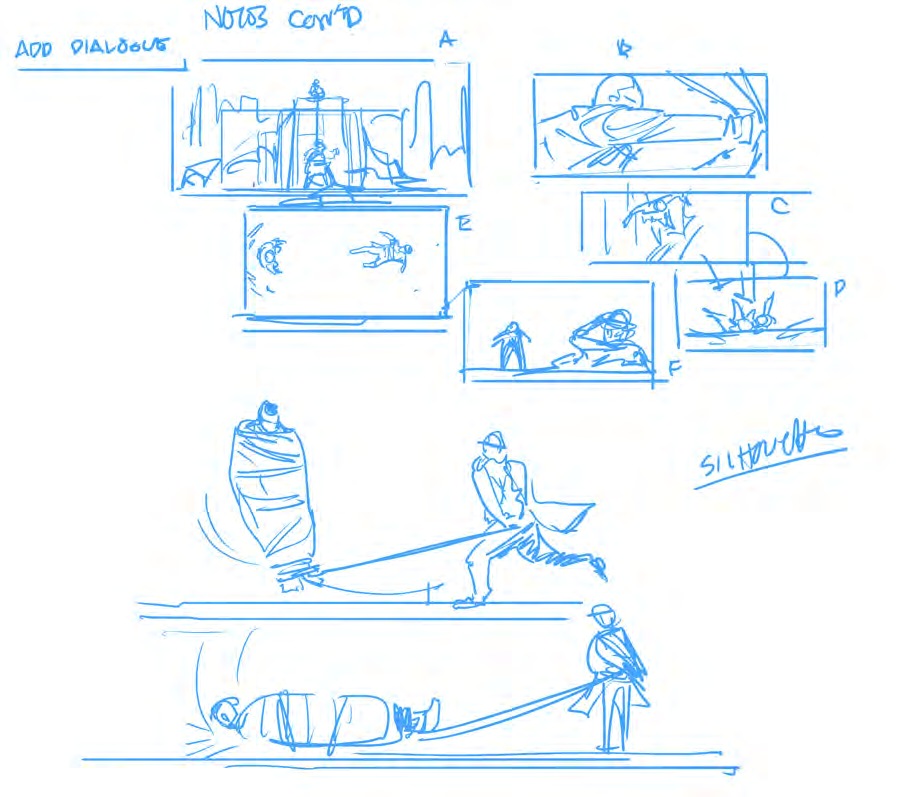
The blue-pencil sheet looks almost impatient beside the shaded sample. Small frames, letters, arrows and gestures share the page. Some figures barely contain more information than a hat, a shoulder line and a direction of movement. Yet the important relationships are there: who faces whom, where an action travels and what the next angle might show.
The lower drawings give the web a clear route across the page. One figure pulls while the other is wrapped and displaced. The line connecting them explains the force more efficiently than a detailed drawing of either costume would. It is a drawing about an action, with anatomy supplying only what that action needs.
Martin drew meeting thumbnails, then blue-line drawings and digital inks. Stunt coordinator Freddy Bouciegues filmed rehearsal footage; Martin revised angles and added action beats around it. After photography, he drew animatic frames for VFX supervisor Hnedel Maximore and the editors. A board could change because the physical action demanded it, keeping the drawing connected to what the crew could shoot.
Make an effect behave from shot to shot
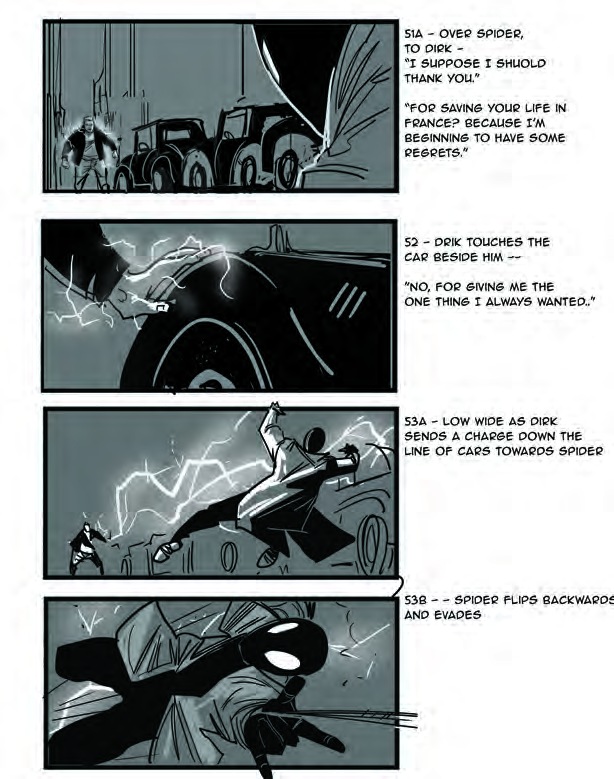
In the electrical encounter, bright branching lines connect the character to the parked cars and then run towards the Spider. The cars supply a repeating path through the frame. The effect has somewhere to begin, somewhere to travel and someone to threaten.
The final close view changes the job of the image. Instead of explaining the route through the street, it brings the response close to us. The pale eye shape becomes the main interruption in the black head. The sequence alternates explanation and reaction; giving every panel the same scale would weaken that rhythm.
The electric branches also need the quieter car bodies around them. Their thin pale edges would disappear against a similarly busy background. The surrounding grey is doing practical work: it gives an unstable, broken shape enough space to be understood.
Let a patch of light establish the room
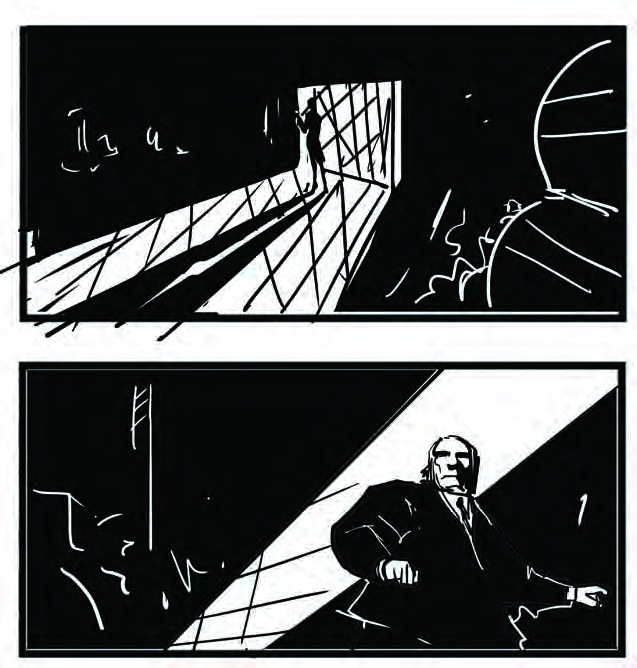
The doorway scene is much quieter. A pale opening throws a long pattern across the floor, while most of the room is left black. We can locate the entrance, the standing figure and the seated person with remarkably little description. The floor pattern provides depth without filling the darkness with furniture.
The closer view retains that division between a lit face and a nearly black surrounding shape. Small white accents identify a hand, an armrest and the edge of clothing. They are selected landmarks. Adding equal detail everywhere would make the room easier to inventory, but the meeting less tense.
Read the frames as a passage of time
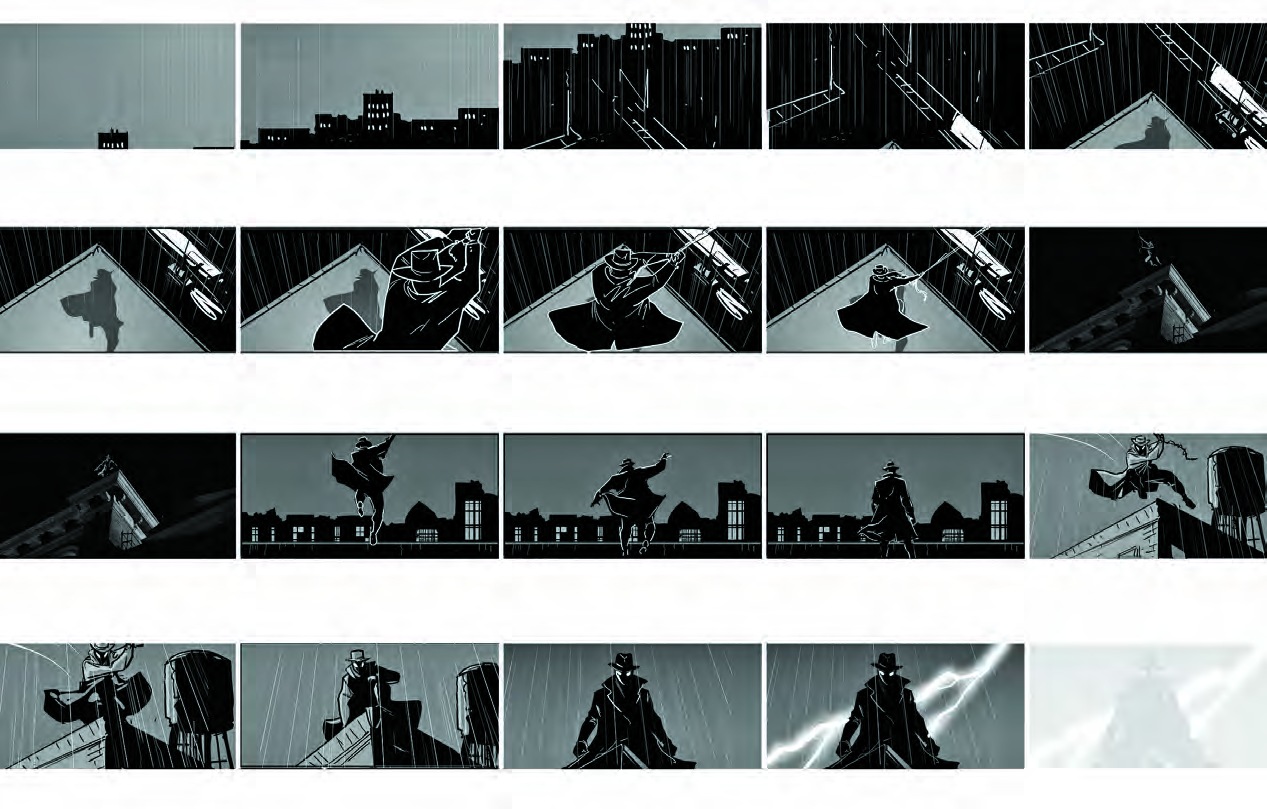
The rooftop sequence begins at a distance, approaches through the buildings and arrives beside the figure. Successive views reuse shapes while changing their size and position. The city becomes a route for the eye, rather than a single impressive backdrop.
On the roof, the coat and the figure’s turn supply movement against a more stable silhouette of buildings. Lightning then transforms the surrounding values. Even on a printed sheet, those changes suggest a rhythm. The point is not to choose twenty equally attractive pictures; it is to make each picture move us into the next.