The most revealing image in this selection is a house shown twice: once as drawings and colour artwork, then as a miniature with a crew member kneeling beside it. The roof, porch and blue siding survive the journey from an image to a place someone can physically work on.
That journey is the subject of The Art of Wildwood, written by Drew Taylor, with a foreword by Colin Meloy and an introduction by director Travis Knight. Rizzoli’s 176-page book, published on October 6, follows character designs into fabrication and looks at the making of LAIKA’s locations and sets.
The story gives that design work a useful starting point. As Rizzoli’s synopsis explains, Prue leaves Portland for the forest after crows carry away her baby brother. She crosses from a familiar city into a place inhabited by animal factions, bandits and ancient Mystics. A recognisable home is therefore part of the fantasy’s construction: it gives the audience something ordinary to measure the strange places against. The domestic setting has a narrative job before the forest has revealed anything.
Who is responsible for the characters?
Thibault Leclercq identifies his role as principal character designer: establishing the look and overseeing character development from initial sketches to the screen. He also separates the credits on the forest image above. The press-release concept is his; its colour version is by Santiago Montiel.
That distinction is useful when studying the picture. The figures and enclosing forest give it its basic arrangement, while the blue-green opening makes their position immediately legible. Colour develops the effect of the drawing. Looking at that collaboration is more informative than searching for a single brush or filter that explains the image.
Prue has to remain herself as she turns

The Prue studies let us compare the same face across several expressions and angles. The head cannot simply look appealing from one preferred view: the relationships between the eyes, nose and jaw have to remain convincing when the pose changes. The tied-back hair and clothing add landmarks that help the character stay recognisable.
A sheet like this gives a different kind of information from a finished character illustration. It exposes the decisions that have to hold together across a performance. For someone studying character design, the comparison between two heads may be more useful than the most polished drawing on the page.
Look specifically at the brows and mouth in Leclercq’s sheet. Some expressions open the face; others pull its features into a small, concentrated region. The large dark coat in the full-body drawing gives the narrow legs and comparatively small hands a different rhythm from the head. These are readable choices before any surface has been painted. It would be easy to lose them while adding detail, especially if a modeller or illustrator treated every region as equally important.
The studies also resist the temptation to turn a character sheet into a row of identical portraits. A tilted head, a profile and an open-mouthed reaction ask different questions of the design. For an illustrator reviewing their own sheet, that variety is a useful standard: have the drawings actually tested the character, or only repeated the most flattering view?
The house is a design hand-off you can see

The Artbook Collector’s preview places the house studies beside the constructed set. The page credits Nelson Lowry and Santiago Montiel. The porch, projecting roof and front steps remain identifiable across the stages; the crew member in the photograph makes the miniature’s actual scale apparent.
The comparison explains why an environment painting needs more than attractive surface detail. Roof angles, openings and the route to the door are decisions another department can act on. The colour treatment adds atmosphere, but the underlying arrangement is what makes the painted and built versions recognisably the same house.
There is a helpful colour relationship here too. The blue exterior makes the small warm openings conspicuous. The windows and doorway read as signs of occupation, rather than decorative rectangles scattered over a facade. Meanwhile the large roof planes remain relatively quiet. The comparison encourages us to look at what stayed consistent through fabrication: the identity of the house survives without every drawn mark becoming a physical object.
That distinction matters when preparing an environment portfolio. A loose atmospheric view can establish an invitation or a threat, while a second drawing resolves access, proportions and the parts that people will touch. Putting those images beside each other makes a proposal easier to evaluate than polishing a single view until every uncertainty is hidden under texture.
A forest needs more than green
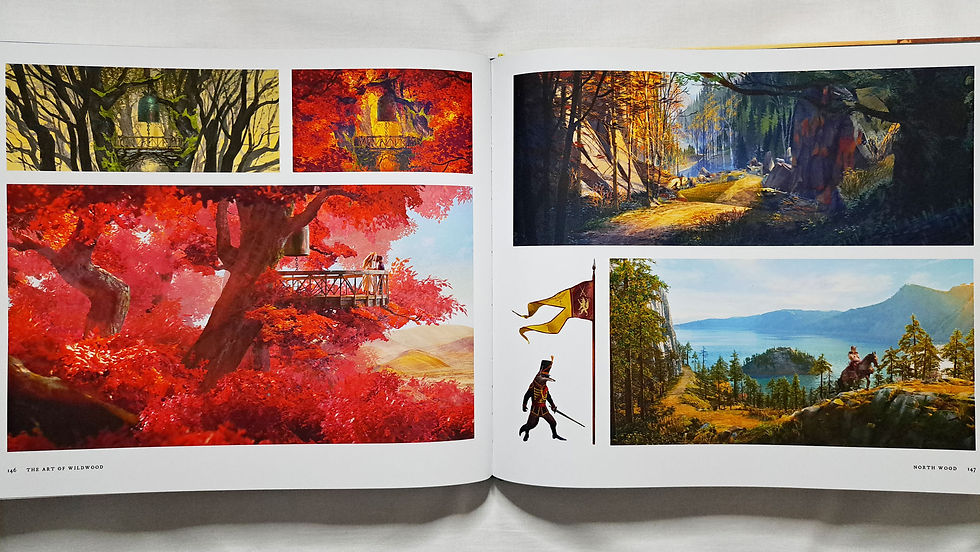
These environment studies are worth viewing together rather than as isolated wallpaper. Changes in the size of light areas, the density of the trees and the colour of distant forms give the locations different moods. For a sequence of images, that variation matters: one convincing forest painting does not establish the range of a whole film.
The book preview and Leclercq’s portfolio offer two useful ways into the project. One follows a character designer’s contribution; the other places drawings, paintings and physical production beside each other. Together they make the art department’s work easier to understand than a gallery of finished film stills alone.